
Na edição de 2026 do QS World University Rankings by Subject, a Universidade do Algarve (UAlg) passa a...
QS - World University Rankings
The QS World University Rankings, produced by Quacquarelli Symonds since 2004, is one of the most influential and widely recognized international rankings in the higher education sector.
Quacquarelli Symonds - World University Rankings
The QS-WUR: Top Global Universities is based on a comprehensive data analysis that reflects institutional performance across multiple dimensions, including: research (quality, volume, and academic reputation); graduate employability (student preparation, industry connections, and employer reputation); learning environment (resources available to support students); internationalization (faculty, student diversity, and participation in international research networks); and sustainability (institutional commitment to the United Nations’ 2030 Agenda and Sustainable Development Goals). The methodology took into account, among other factors, 16.4 million scientific publications, around 200 million citations, 1.5 million academic nominations, and over 500,000 employer references, assessing institutions on five key pillars:
- Research and Discovery (50%)
- Employability and Outcomes (20%)
- Global Engagement (15%)
- Learning Experience (10%)
- Sustainability (5%)
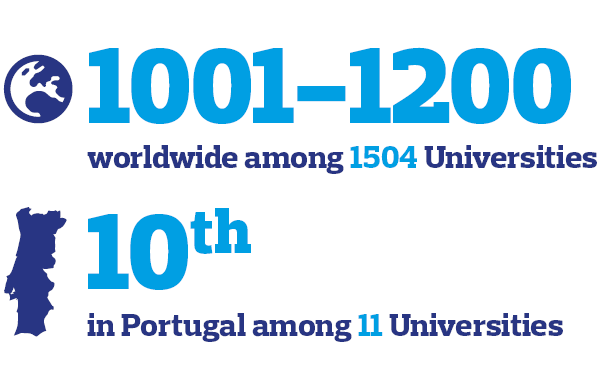
In the 2027 edition of the World University Rankings, the University of the Algarve is ranked between 1001 and 1200, and stands out particularly in the ‘International Students’ indicator, occupying the 433rd position worldwide in this category, amongst the 1504 institutions assessed, from 106 countries or regions.
More information here.
QS World University Rankings - Results
| Edition | World | No. HEI World | Portugal | No. HEI Portugal |
|---|---|---|---|---|
| 2027 | 1001-1200 | 1504 | 10 | 11 |
| 2026 | 1001-1200 | 1501 | 7-9 | 9 |
QS Europe University Rankings - Results
| Edition | Global Score | Position Europe | No. HEI Europe | Southern Europe position | No. HEI Southern Europe | Portugal position | No. HEI Portugal |
|---|---|---|---|---|---|---|---|
| 2026 | 32.2 | 373 | 960 | 83 | 209 | 9 | 26 |
| 2025 | 17.7 | 407 | 684 | 94 | 147 | 9 | 12 |
| 2024 | n/a | 511-520 | 688 | =117 | 146 | 11 | 12 |
Quacquarelli Symonds - World University Rankings by Subject
The 2026 edition of the QS World University Rankings by Subject covers 55 specific subject areas, grouped into five broad subject categories. This year’s edition is the largest ever, featuring over 1900 institutions, more than 300 of which are appearing for the first time. Find out more and view the full results of this ranking here.
QS - WUR by Subject - Results
| Edition | Specific Area | World Position | No. HEI World | Portugal Position | No. HEI Portugal |
|---|---|---|---|---|---|
| 2026 | Archaeology Environmental Sciences Hospitality & Leisure Management | 201-260 501-550 151-175 | 260 553 174 | 1-4 6 1 | 4 6 1 |
| 2024 | Agriculture & Forestry | 351-400 | 450 | 5 | 6 |
| 2023 | Agriculture & Forestry | 351-400 | 422 | 6 | 7 |
Quacquarelli Symonds - World University Rankings
Using a methodology composed of indicators designed to measure an institution's ability to address the world's greatest environmental, social, and governance (ESG) challenges, the QS Sustainability Rankings 2026 presents results from 2,002 higher education institutions deriving from 108 countries/locations worldwide, of which 621 are European and 14 are Portuguese. In this latest edition, UAlg ranks =577 globally, a significant improvement on the previous edition. This improvement is largely due to the results obtained in the areas of “Environmental Education” and “Environmental Research,” where UAlg stands out, ranking 186th and 251st, respectively. You can find more information about this ranking here.
This ranking offers a unique perspective on institutions that are demonstrating a commitment to a more sustainable existence. More than just commitment, it seeks external evidence of this fact—from the impact that alumni are having on science and technology to solve climate problems, to the impact of research being done on the UN's 17 Sustainable Development Goals.
The QS Sustainability Rankings are determined using 52 indicators, grouped into 9 themes, and then encompassed in 3 main categories:
Environmental Impact (45%) - This category recognizes the efforts that universities make to improve the planet, whether through their research in areas such as the environment and climate science, through a strategic focus on climate change mitigation, or through the impact that their alumni have had in creating a more sustainable world.
Social Impact (45%) - This category assesses the university's ability to contribute to a better society, whether through equality measures, sharing knowledge and learning from others, delivering strong outcomes for graduates, and ensuring that students have an excellent experience while under its care.
Governance (10%) - This category analyses whether universities have good governance embedded in their policies, procedures, and strategies. The ability to deliver on SDG commitments is recognised by the UN as dependent on the coordination and implementation of good policies and practices through good governance.
QS Sustainability Rankings - Results
| Edition | Overall Score | World Position | No. HEI World | Europe Position | No. HEI Europe | Portugal Position | No. HEI Portugal |
|---|---|---|---|---|---|---|---|
| 2026 | 65,9 | =577 | 2002 | =245 | 621 | 8 | 14 |
| 2025 | 47 | =883 | 1743 | 301-350 | 556 | 10 | 12 |
| 2024 | n/a | 841-860 | 1397 | 351-400 | 490 | 9 | 12 |


